Rat-catchers attack and seize Keith, Malicia, and Hamnpork
The Amazing Maurice and His Educated RodentsThe rat-catchers’ attack and seizure of Keith, Malicia, and Hamnpork is a decisive reversal: an encounter that begins with the rat-catchers accusing the intruders of breaking in becomes an assault, a failed attempt at resistance, and the removal of both humans and rats into captivity. Maurice watches from out of reach. The scene’s importance extends beyond the immediate capture, revealing the vulnerability of individuals facing organized force and sharpening the contrast between a panic-struck crowd and the disciplined Clan.
The confrontation in the shed
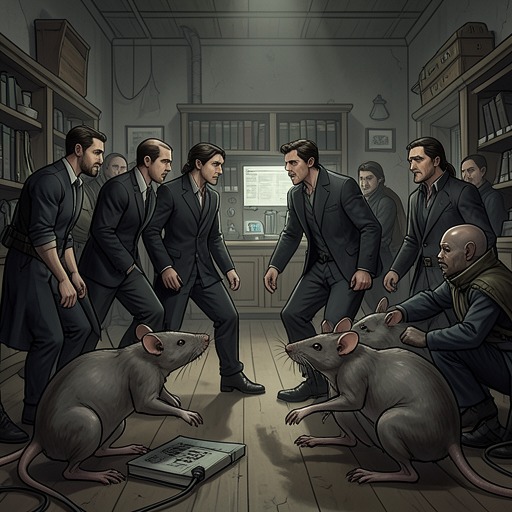
The encounter begins when Rat-catcher 1 spots Malicia and Keith and demands to know why they are there. He presents their presence as trespassing, shifting attention from what the rat-catchers are doing to the supposed offence of their visitors. The exchange turns abruptly hostile; Maurice’s narration marks the break with the observation that the story has gone wrong. That change matters because the scene has been shaped by expectations of a familiar adventure, while the people in the shed behave according to the harsher logic of an actual confrontation.
Rat-catcher 1 strikes Malicia and knocks her against the cages. The rats inside respond in agitation, turning the cages into a visible measure of how many lives are caught up in the confrontation. Rat-catcher 1 then threatens Keith with confinement among the unfed rats. The captors’ confidence is not simply a matter of physical advantage: they control the room, the cages, and the terms on which their prisoners can be moved. Their treatment of the captured rats is already implicit in the threat.
Keith gets up and punches Rat-catcher 1, but the blow does not produce the storybook reversal Maurice expects. Rat-catcher 1 knocks Keith down again. Maurice’s thoughts reveal how strongly he has begun to anticipate the conventions of heroic tales: he imagines that anger will grant Keith exceptional strength and assumes that he will rise after being beaten down. The actual scene denies both expectations. Keith acts with ordinary human strength, and the captor remains physically dominant.
Hamnpork’s intervention and capture
A sudden attack from above briefly changes the balance. A grey rat leaps from the cages onto Rat-catcher 1, who catches him and holds him by the tail. Maurice initially mistakes the rescuer for Hamnpork arriving to save the humans, then recognizes that he is once again reading events as though they were arranged for a satisfying story. Hamnpork is the rat in the captor’s grasp, not a triumphant rescuer. His fierce resistance does not free him.
The rat-catcher’s response makes the hierarchy of the scene plain. He praises the rat’s fighting spirit, but clarifies that he is addressing the animal rather than Keith, whom he prods with his boot. In the same exchange, he orders the prisoners moved to another cellar, specifying a proper door and lock and the absence of a convenient trapdoor. The details make the planned confinement deliberate: the captors have learned to think about escape routes and mean to prevent another one.
The seizure is completed when the rat-catchers open several cages, take rats, and put them into a sack. Hamnpork is included. They leave dragging the other humans with them, while Maurice remains behind, asking himself how a cat his size could get out of the maze of cellars. The action therefore divides the group: Keith, Malicia, Hamnpork, and the other captured rats are carried away, while Maurice is isolated and must find his own route through the cellar network.
Maurice’s separation and the wider danger
Maurice’s position turns the capture into more than a scene of defeat. He sees the rat-catchers leave but cannot follow through the door or reach the prisoners. A shaft of moonlight enters through a hole too small for him; the adjoining cellar contains barrels and broken cages, and the doors have handles he cannot operate. He eventually finds a drain grating and squeezes through it. The practical obstacles underline the difference between knowing what has happened and being able to intervene: Maurice’s intelligence cannot make every human-made space usable to a cat.
The danger extends beyond the people taken from the shed. Elsewhere, rats running past Peaches and Dangerous Beans have been so frightened that one squeals and gibbers instead of speaking. Dangerous Beans recognizes that they have forgotten how to talk, and Peaches gathers her notes as she fears that something terrible has frightened them. The episode places the capture within a broader crisis in which fear threatens the rats’ capacity for thought and communication, not merely their physical safety.
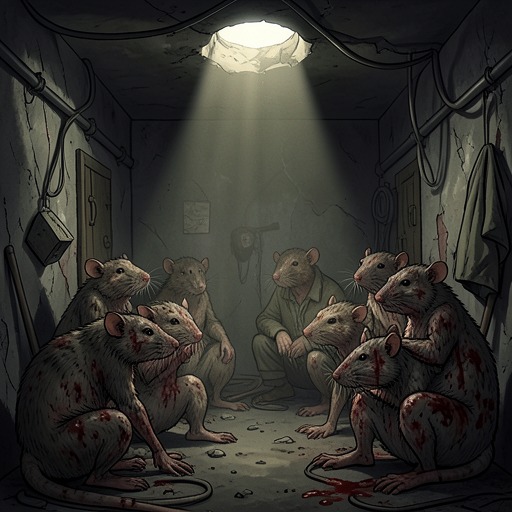
That distinction is tested when Maurice later explains rat-coursing to Darktan. In the practice he describes, rat-catchers bring live rats to a ring where dogs are set on them; the rats mostly run in circles rather than fight. Darktan asks why they do not resist. Maurice explains that a single rat may think and show courage, while a crowd overwhelmed by shared fear can behave like one many-legged animal without a brain. The account gives a wider context for the captors’ power: exploiting rats as a mass is different from confronting thinking individuals or a coordinated community.
From panic to coordinated resistance
Later events offer a sharp contrast to the disorder associated with frightened rats. Darktan addresses young rats in the tunnels, telling them that their ability to think and their refusal to run are strengths. He uses the image of the Dark Wood and the Bone Rat to give their danger a shared shape, turning fear into a common objective. His speech does not erase the threat; it gives the group a way to face it together.
When the Clan attacks its enemies, the rats move in a line that closes around an attacker like a fist. If the opposing rats panic and scatter, the formation breaks into pairs that pursue them. The war ends quickly. Set beside the earlier flight and the sack of captives, this coordinated action shows the difference between a crowd driven by terror and a group capable of collective discipline. The Clan’s strength lies not in individual rats becoming physically invulnerable, but in their capacity to remain together and respond as a community.
The wider resolution also changes the terms on which humans and rats meet. During the contest with the piper, Keith takes the pipe and persuades him to lead the rats out of town, offering to share the job and the payment rather than treating the piper as an opponent who must simply lose. Later, Darktan approaches the mayor with a proposal rather than a threat, and Maurice describes a possible arrangement in which people and rats agree on rules for sharing food. These later negotiations do not undo the capture, but they carry the central conflict beyond force: the rats’ capacity to think becomes the basis for bargaining and coexistence.
Significance
The attack exposes the distance between the stories Maurice expects and the reality in front of him. Keith does not become superhuman, Hamnpork’s brave charge does not save the prisoners, and Maurice cannot instantly turn intelligence into escape. Yet the event does not define the rats as helpless. Their later recovery of speech, their organization under Darktan, and the eventual human-rat negotiations demonstrate other forms of agency: shared identity, discipline, and agreement.
The episode’s decisive reversal is therefore twofold. In the shed, the rat-catchers convert control of cages and cellars into control over their captives. Across the larger story, that apparent mastery is challenged when the rats cease to act as a terrified mass and insist on being treated as thinking participants. The capture establishes the danger; the Clan’s later cooperation and the proposed accord show what can answer it.